
Why First Start Reading?

First Start Reading is Memoria Press’ phonics program that covers the kindergarten phonics taught at Highlands Latin School. After completing First Start Reading, our first and second graders continue with Classical Phonics and Traditional Spelling.
Why did we write Frist Start Reading Program?
Let’s face it, there are so many phonics programs out there that finding one is not the real problem—it’s choosing one! Ever since Why Johnny Can’t Read was published in 1955, phonics programs have multiplied like rabbits. In the early days at Highlands Latin School we had been patching together different phonics materials—each of which had some features we liked, but not all—so we wrote a program that would include all the components necessary for a robust Kindergarten reading program.

1. Printing Component
A phonics program that combines printing instruction and practice with phonics allows students to print the words they are learning to read. The primary purpose of a phonics program is to teach a child to read, but spelling and printing are an important—though secondary—skill. If you are teaching letters and sounds to a three- or four-year-old, you definitely do not want to put much emphasis on printing, if any at all. But, for the five- and soon-to-be-six-year-olds in kindergarten, it’s time to start working on those printing skills.
Though printing is not a necessary skill for reading, it is a valuable learning pathway. It forces the student to slow down, sound out, notice details, spell, and practice fine motor skills. There is nothing more direct and effective than printing new words for the beginning reader. Since they are going to have to practice printing with something, why not the phonetic words they are learning to read?
2. Correct Pencil Grip
It is difficult to find a program that gives pencil grip its due, or one that gives the teacher the techniques needed to teach and monitor pencil grip. It can be daunting to get a child to change his pencil grip if it is an ingrained bad habit, but what hand skill do we learn that is more important than writing? Your child’s tennis or golf coach will insist on correct grip and so, also, should we insist on correct pencil grip. This is not an item of personal preference. Correct pencil grip reduces hand fatigue and will make the writing component of an academic education much more pleasant.
3. Directionality
Moving the eyes and hands from left to right when blending and reading is a critically important physical skill for the beginner. Most children catch on to this quickly, but there are always a few who struggle and become confused with the left-right directionality of reading, so there is no reason to take any chances. First Start Reading requires students to trace with a pencil on a dotted line underneath all the blending and reading throughout the whole program. By printing all the words they are sounding out and reading, left-right directionality is constantly reinforced for students. The amount of repetition in FSR ensures that every child masters this skill.
4. Traditional Phonics
Classical Phonics: A Child’s Guide to Word Mastery was originally published in 1913 (under the title Word Mastery), and was a gold standard for traditional phonics at the turn of the century, before the look-say programs of the 1940s. It is an outstanding example of the traditional and commonsense approach to teaching phonics, which is why we republished it and use it to practice word families alongside First Start Reading. In traditional phonics, the student learns the short vowel sounds and one sound for each consonant initially, practicing these sounds in three-letter consonant-vowel-consonant words, such as pat, pet, pit, pot. After mastering short vowels, the exact order of new phonetic principles is not critical, but most traditional phonics programs are fairly consistent in adding new sounds in a logical, orderly way. A typical order would be consonant blends, long vowels with silent e, long vowel teams, digraphs, sounds of y, etc. These phonetic principles are taught in the context of word families. This sensible approach to phonics is almost immediately understandable by the teacher and student.
A nontraditional approach to phonics, developed in the last half of the twentieth century, requires students to learn all the sounds for each phonogram (the letters and teams that spell the sounds of the English language) initially and to use “spelling rules” to apply them. Using this approach subordinates reading to spelling and makes the process of learning to read unnecessarily complicated.
5. Blending
One more feature that makes First Start Reading a strong phonics program is the use of s and the liquid consonants (l, m, n, r) for beginning blending rather than the stop consonants (b, p, d, g, t). Sand the liquid consonants can be voiced without a vowel sound, which is impossible with the stop consonants. Using the liquid consonants for blending eliminates this problem so the child is not trying to sound out bat like “buh-a-t.” That “uh” has to be voiced with the stop consonants but not with sand the liquids. First Start Reading begins with all of the consonants that can be blended smoothly and without any intervening vowels (m, s, n, r, f).
6. Slow Down
Other phonics programs tend to rush over short vowel sounds and blending much too quickly. The sounds of the consonants are easy to learn because most of them say their sounds in their names (w, y, c, and gare exceptions), but the vowels, on the other hand, are very nuanced and their sounds are very similar—especially eand i. These are by far the most difficult sounds in phonics, but what a difference they make! Pit and pet are very different words, but eand imake such similar sounds. First Start Reading provides mastery learning for the short vowels, incorporating the same mastery drill found in Classical Phonics. The short vowel words are drilled three ways and then followed up by an assessment. First, students must read the beginning consonant correctly in a list of words, as all of the words rhyme. Second, students must read the vowels and ending consonants correctly as all of the words begin with the same consonant. In the last list, students must know every consonant and vowel. Each assessment is important and identifies potential problems. When students sail through the last assessment they know the primary sound for each consonant and the short vowels, and they are ready to move on to the next phonetic principle. It’s this kind of assessment that informs the teacher what the student really knows and can do, and that ensures a solid foundation is laid down in the beginning. The short vowel sounds are just too important to rush over.
7. Child’s Book
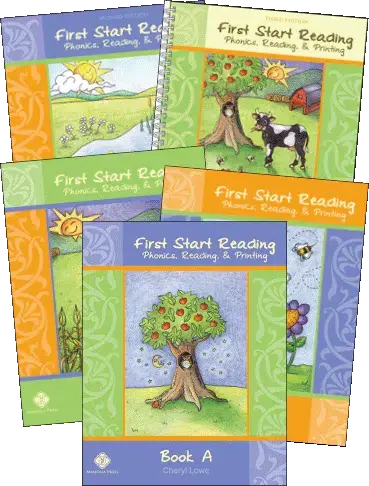
First Start Reading consists of five consecutive workbooks for the child, enabling him to complete all of his work in an orderly way. For each letter, there are coloring pictures, drawing space, printing lines, and, finally, writing lines and stories to read. At the end of the course, parents have all of the child’s important work from that magical first year in convenient books.
8. Beauty and Order
Anybody familiar with Memoria Press products knows that we like direct, simple, thorough, orderly materials and mastery learning. No distracting, busy pages, no cartoons or clip art, and no frills—just classic design and handsome, age-appropriate art. Students shouldn’t be forced to use materials that are silly, ugly, cartoonish, and insulting to the child, as if children have to be entertained to keep their attention.
Adults may be bored with the unvaried format of the books in First Start Reading, but that is because adults do not have the child’s delight in repetition and dislike for surprise and change. Children like the same format for every lesson. They work securely and happily because they know what to expect and what they need to do.
Cheryl Lowe writer of First Start Reading
Cheryl Lowe was the author of the popular Latin programs, Latina Christiana, Lingua Angelica, and the Forms Series. She and her husband, Jim, were married for forty years and have two sons, both of whom were National Merit Finalists. Cheryl discovered Latin when she homeschooled her sons and was a self-styled apostle of Latin, claiming that Latin has more educational value than any other subject you can teach your children. Cheryl graduated from the University of Louisville with a degree in chemistry and from Western KY University with an M.S in Biology. Cheryl had wide teaching experience, in both content and venue, teaching everything from phonics, reading, math, Bible, and chemistry to Shakespeare and Latin, and teaching in public and private schools, as well as homeschooling. Cheryl and her son Brian founded Memoria Press in 1998 and in 2000, the highly successful Highlands Latin School where all of the Memoria Press products are taught and field tested.


Comments