



Linear Abacus is an Australian-designed maths system for children aged 5–14, built around a single hands-on tool that works across number, arithmetic, measurement, and algebra. The approach is built on a simple three-step framework — Talk, Do, Write — that guides parents through every lesson, so you always know what to say, what to look for, and how to help your child record their thinking. We stock the full product range including bead strings, the Games Book, instructional manual, flashcards, and value sets.
A Simple and Powerful
'Swiss Army Knife'
for showing students how to think
with and undstand Numeration and
Measurement
What is a Linear Abacus®? The Visual Math Tool That Makes Numbers Make Sense

What is a Linear Abacus®? The Visual Math Tool That Makes Numbers Make Sense

Counting to 100 Song | Math Cartoons for kids | Linear Abacus®

How to Find the Difference Between Numbers | Additive Thinking | Linear Abacus®
EXPLORE & MODEL A RANGE OF
MATHEMATICAL AREAS WITH ONE
SIMPLE TOOL



Counting using one-to-one correspondence to order an unordered collection. This is the first notion of a number.
Numeration – naming numbers using base 10 place value. The Linear Abacus helps students expand numbers multiplicatively.
Number operations and basic facts are explored through concrete and visual representations. Here a student discovered the connection between quotative division and multiplication. The Linear Abacus helped them construct the number line and array model.


Area is explored through ‘covering’. Here a square metre is being constructed. Students discovered that 100 strings were required to cover the square metre. The Linear Abacus® helped them see the submultiples of the unit and convert between units.
Volume is explored through ‘filling’ boxes. The Linear Abacus helps students understand the formula to find the volume of prisms i.e., base area x height.
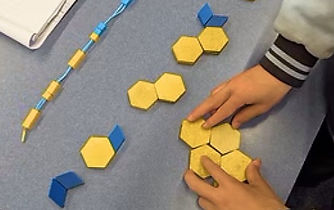
Growing Patterns made with pattern blocks are connected to the Linear Abacus. This helps students describe the pattern and recognise how it changes in each step. In this example, they were exploring skip counting with fractions: 2/3, 4/3, 6/3…
KEY FEATURES
-
The Linear Abacus® is a foundational model of number for young children. Made up of multi-coloured cubic centimetre beads, threaded with a double string to keep the beads in place. Excess string is provided to allow children to perform various calculations with ease.
-
The abacus string reflects the structure of the base 10 place value system. Each consecutive group of ten beads alternate colours, for example, ten yellow beads, ten blue beads and so forth. This pattern repeats 5 times over as there are a total of 100 beads on the string.
-
The Linear Abacus® is multifunctional and since cubic centimetre beads are used, the full 100-bead abacus string is equivalent to the measure of 1 metre. This means that the abacus string can also be used in measurement to model length, area (as a process of covering), and volume (as a process of filling).
-
Class sets can be used for rich collaborative problem solving and modelling to build deep number and measure intuitions. For instance, children can build a square metre, explore the number of strings used to circle an oval, or determine ways to convert between metric units of length, area, and volume.

The Linear Abacus helps students learn and make sense of mathematical concepts.
It was designed to provide a consistent multiyear resource for teaching algebraic thinking as the basis for STEM subjects. The development and inspiration of the Linear Abacus® was motivated by the need to find simple but rich manipulatives that can be used easily in the developing world to teach number, measure, and arithmetic from prep through to grade 8.
HOW TO READ THE LINEAR ABACUS
The abacus string can be read in different ways. Each of these interpretations are based on the idea that each bead is 1cm in length (as the beads are a cubic centimetre).

An individual bead on the abacus string can be thought of as a count because each bead is an object in an order. The counts are represented as numerals on the bead face and are colour coded red. The figure to the left shows a count of 5 discrete things. The numeral 5 links to the fifth thing counted.
A span or a measure (in the sense of a ruler) on the Linear Abacus starts from the beginning of the abacus string to the end or boundary of one bead to the next. These numerals are colour coded purple. On the abacus string this is shown as an annotated arrow below the string. The figure to the right shows an informal measure of 5 units.
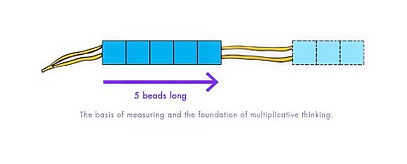

When two beads touch, a point is found on the abacus string. Each of the points between the beads on the abacus string can be thought of as marks on a scale or a number line. These numerals are colour coded black and are marked as dots between the beads. The figure to the left shows the 5th centimetre mark on a scale.
WAYS TO USE THE LINEAR ABACUS
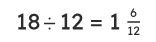
In the classroom the process of expressing and developing an understanding of concepts is facilitated by the discourse between teachers and students, students with other students, and students with themselves. For instance, if a child is given a simple number sentence (SNS) such as 18÷12=1½ and they are able to build a model on the Linear Abacus®, interpret a word problem, or do a calculation, whilst connecting all three interpretations simultaneously, then it is safe to assume that they have understood a concept in arithmetic.
In this problem students are comparing 18 to 12 multiplicatively.
SNS
18÷12=1½
On the Linear Abacus Model
Start by locating Jack and Jill’s bead on the abacus string as both are things that can be counted.
In the World
Jack has 18 marbles in a bag, and Jill has 12 marbles in a bag. How many times more marbles does Jack have than Jill?


On the Linear Abacus Model
Then ask yourself, “how many times does Jill’s total go into Jack’s total?” The arrows above the beads show the answer and dashed beads have been included in the diagram to show how many times Jill’s total goes into Jack’s total. This can also be performed with a second abacus string.

Another way to interpret this is to let 12 marbles be one full bag. If 12 represents 1 bag, then 18 is one bag and 6 out of a second bag.
Using a Calculation
The diagrams below include both the additive and multiplicative interpretations.
An additive interpretation:


An multiplicative interpretation:

